.png)
One of the greatest emerging risks in digital transformation is that organizations may act confidently on information they cannot prove is authentic, accountable, or trustworthy
Digital transformation has made organizations faster, more connected, and more automated. It has also created a dangerous assumption: that information can be trusted simply because it arrived through a digital system.
That assumption is breaking down. A convincing message may be fraudulent. A business document may have changed after approval. An AI-generated summary may omit a critical fact. An automated agent may act on information that it was technically able to access but was never intended to use. In each case, the technology may operate exactly as designed, yet the resulting business decision may still be wrong, ungoverned, or indefensible.
''An AI-generated summary may omit a critical fact.''
For executives and technology leaders, this is the emerging risk at the centre of digital business.
Cybersecurity can protect systems. Identity management can authenticate users. Neither capability, by itself, proves that the information moving through a process is trustworthy or that every human and AI participant should have access to it.
''...the technology may operate exactly as designed, yet the resulting business decision may still be wrong, ungoverned, or indefensible.''
Organizations now need a new operational layer: Trust Infrastructure.
We use the term Trust Infrastructure to describe the emerging collection of governance, accountability, traceability, authorization, and verification capabilities that are becoming necessary in digital and AI-enabled organizations. While the market uses terms such as Digital Trust, Trustworthy AI, Information Governance, and Zero Trust, these concepts increasingly converge around a common objective: establishing confidence in the information, decisions, and automated processes that drive modern business operations.
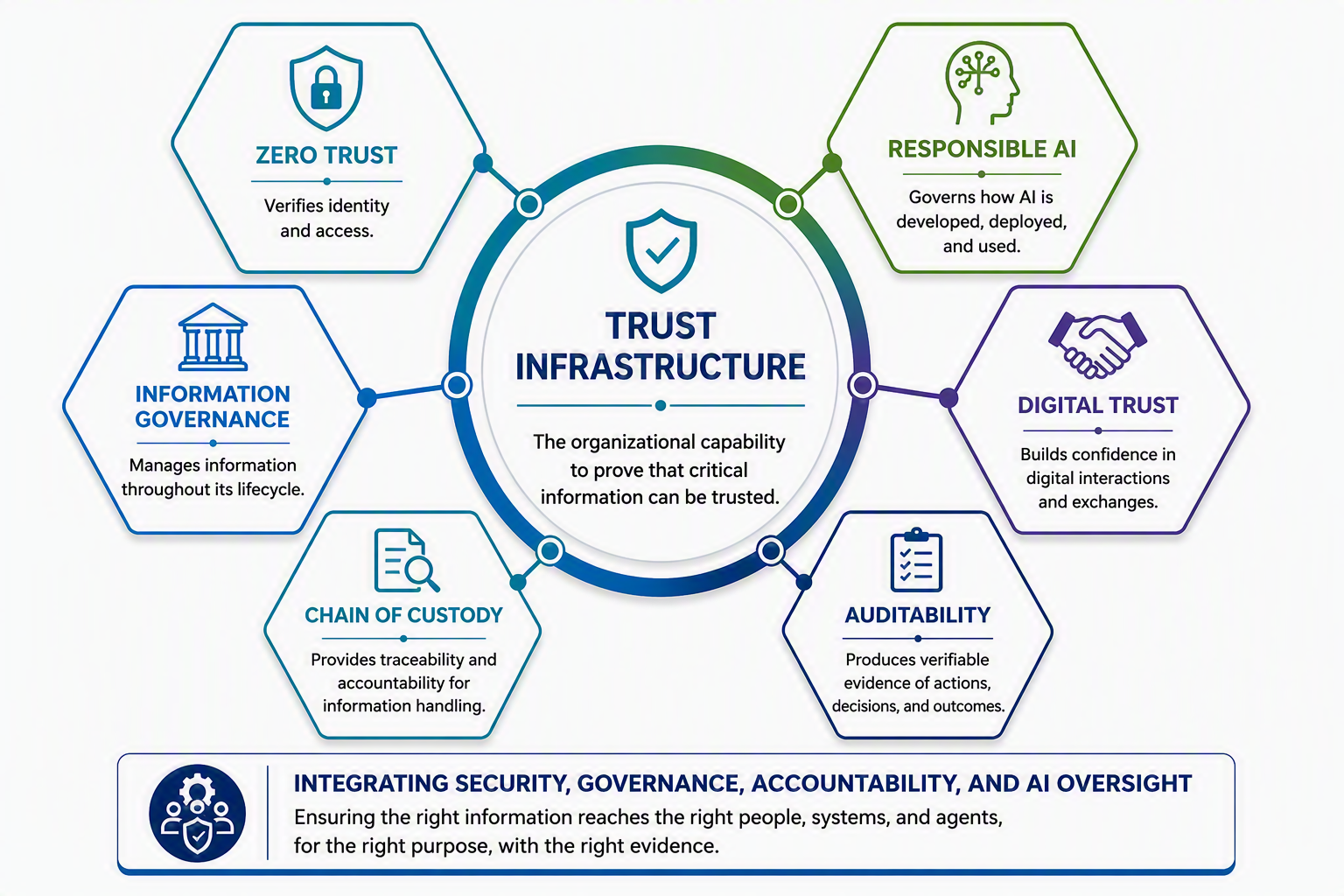
At its core, Trust Infrastructure is the organizational capability to prove that critical information can be trusted. It encompasses governance, traceability, accountability, access control, auditability, and verification mechanisms that enable organizations to exchange information with confidence and make decisions based on it.
''...Trust Infrastructure is the organizational capability to prove that critical information can be trusted.''
From Digital Access to Digital Confidence
The first waves of digital transformation emphasized connectivity, accessibility, and efficiency. Networks connected the workforce. Cloud services made information available anywhere. Workflow automation accelerated routine processes. More recently, artificial intelligence has begun to generate content, interpret records, recommend actions, and participate directly in business workflows.
Each wave created value, but also increased the number of systems, participants, transitions, and decisions involved in the information lifecycle. Modern digital ecosystems depend on data, cloud platforms, software providers, partners, and automated tools working together. The International Organization for Standardization (ISO) has noted that technical capability alone is insufficient for adoption at scale: trust must be demonstrated through common expectations, governance, testing, and credible evidence.
EXECUTIVE PERSPECTIVE
If an organization cannot explain where critical information came from, who or what accessed it, how it changed, and why it was trusted, then it does not have a technology problem alone. It has a governance and accountability problem.
Defining Trust Infrastructure
Trust Infrastructure is the combination of systems, processes, policies, evidence, and communication frameworks that allows an organization to verify, govern, trace, and confidently exchange business-critical information.
It sits between secure technology and trusted outcomes. Its purpose is not to declare every message, document, or AI output “true.” Its purpose is to create sufficient evidence, context, control, and accountability for people and systems to decide what can be trusted, by whom, for which purpose, and under what conditions.
Trust Infrastructure, therefore, extends beyond traditional security. It encompasses information classification, access governance, origin, approvals, delivery evidence, lifecycle management, audit records, and human oversight. It must account not only for employees and external partners, but also for AI assistants, applications, agents, models, and automated workflows that may retrieve, transform, summarize, or act on organizational information.
TRUST INFRASTRUCTURE VS. EXISTING FRAMEWORKS
- Zero Trust: Verifies identity and access.
- Information Governance: Manages information throughout its lifecycle.
- Responsible AI: Governs how AI is developed and used.
- Digital Trust: Focuses on confidence in digital interactions.
Trust Infrastructure: Brings these capabilities together to establish confidence in the information, decisions, and automated processes that drive the organization.
AI Turns Information Governance into an Executive Issue
Responsible AI cannot be separated from responsible information management. An AI system’s usefulness depends on the information it can access. Its risk also depends on that access.
Before an enterprise connects AI tools to business content, it must understand what information it holds, how sensitive it is, who owns it, how long it should be retained, and which people or systems should be permitted to use it. If information is poorly categorized or permissions are overly broad, AI can expose an existing governance weakness at machine speed.
This changes the access-control question. Organizations must move from asking only, “Which users have access?” to asking, “Which humans, applications, AI tools, models, and agents can access this information, for what approved purpose, and with what oversight?”
According to the NIST AI Risk Management Framework, trustworthy AI incorporates characteristics such as reliability, safety, security, accountability, transparency, explainability, privacy, and fairness. It also links trustworthiness to organizational behaviour, datasets, model choices, human oversight, and the context in which AI is deployed. AI governance is therefore not a policy document sitting beside the technology. It is an ongoing management discipline throughout the AI lifecycle.
RESPONSIBLE AI CHECKPOINT
Organizations should not assume that inherited user permissions automatically represent appropriate AI permissions. Organizations need explicit decisions about which information an AI capability may retrieve, combine, infer from, retain, or use to initiate action.
The Six Pillars of Trust Infrastructure
1. Verified Delivery
Critical information must reach the intended destination through a controlled and verifiable channel. For legal notices, policy changes, financial instructions, healthcare communications, and other high-consequence exchanges, proof of sending is not the same as proof of delivery.
''Critical information must reach the intended destination through a controlled and verifiable channel.''
2. Delivery Confirmation
Organizations may also need evidence that information was received, opened, acknowledged, or acted upon. The level of confirmation should match the business risk. This reduces ambiguity and establishes clear accountability for next steps.
3. End-to-End Traceability
A trusted process preserves visibility from creation through use. Who created the information? Which system transformed it? Was AI involved? Who reviewed or approved it? Where was it sent? Traceability allows an organization to reconstruct the sequence rather than rely on fragmented recollection.
4. Chain of Custody
Chain of custody records who or what handled an asset, when it was transferred, and why. CISA applies the concept to physical and digital assets and links it to transparency, accountability, and risk mitigation. In day-to-day business, the same principle can strengthen confidence in contracts, submissions, approvals, evidence, and regulated records.
5. Centralized Governance
Trust requires consistent ownership and decision rights. Governance should define information categories, sensitivity, retention, acceptable use, access rules, exception handling, and accountability for both human and AI use. Without centralized direction, controls vary by team and trust becomes difficult to sustain.
6. Comprehensive Auditability
Auditability turns trust from assertion into evidence. A mature organization can show what happened, when it happened, who or what was involved, which policy applied, and how an outcome was approved. This evidence supports compliance, incident response, dispute resolution, and continuous improvement.
What Leaders Should Build Now
Trust Infrastructure does not require a single product or a wholesale replacement of existing platforms. It requires organizations to connect capabilities that are often managed separately and align them to business risk.
1. Classify the information that matters most. Identify business-critical, sensitive, regulated, and high-consequence information. Define ownership and handling expectations in language that business and technology teams can apply.
2. Map human and machine access. Document which users, groups, applications, integrations, AI tools, and agents can access each information category. Review whether that access remains appropriate for the purpose.
3. Define evidence requirements by risk. Determine where delivery proof, acknowledgement, approval history, origin, or chain-of-custody records are required. Not every interaction needs the same level of control.
4. Embed responsible AI governance. Maintain an inventory of AI use cases and systems, assign accountable owners, assess risks and impacts, define permitted data use, require appropriate human oversight, and monitor performance across the lifecycle.
5. Design for traceability and audit. Ensure critical workflows generate sufficient logs, metadata, approval records, and explanations to reconstruct what occurred without depending on individual memory.
6. Test trust continuously. Audit access, challenge assumptions, rehearse incident scenarios, investigate control gaps, and update governance as technologies, threats, and business processes evolve.
BOARD-LEVEL QUESTIONS
Can we identify our highest-consequence information flows? Can we prove who can access them and what they can access? Can we reconstruct how a critical decision was reached? Can we show where AI participated and where human accountability remained?
Trust Will Be the Constraint on Scale
Artificial intelligence will expand the speed, reach, and autonomy of digital operations. Its long-term value, however, will depend on whether boards, regulators, employees, customers, and partners have credible reasons to trust its use. ISO has framed this directly: trust must be demonstrated and continually tested and renewed as technologies, risks, and dependencies evolve.
''...trust must be demonstrated and continually tested and renewed as technologies, risks, and dependencies evolve.''
The organizations best positioned for the next era of digital transformation will not necessarily be those that deploy the most AI or automate the most processes. They will be those who can scale innovation without losing control of information, accountability, or evidence.
The first generation of digital transformation focused on moving information faster. The next generation must ensure that information can be trusted. In an AI-enabled enterprise, trust can no longer be assumed. It must be engineered, governed, and continuously demonstrated.
''In an AI-enabled enterprise, trust can no longer be assumed.''
Trust Infrastructure is not another technology layer. It is the operating discipline that allows digital business and AI to scale without outrunning accountability.
The ideas in this article were informed by ongoing work and industry discussions on Digital Trust, Responsible AI, Information Governance, and emerging guidance from organizations such as ISO, NIST, CISA, and others.
Citations
International Organization for Standardization, “Trust is the infrastructure of scale.”
https://www.iso.org/thought-leadership/cybersecurity-digital-age
National Institute of Standards and Technology, “AI Risk Management Framework.”
https://www.nist.gov/itl/ai-risk-management-framework
NIST AI Resource Center, “AI Risks and Trustworthiness.”
https://airc.nist.gov/airmf-resources/airmf/3-sec-characteristics/
Cybersecurity and Infrastructure Security Agency, “Chain of Custody and Critical Infrastructure Systems.”
https://www.cisa.gov/sites/default/files/publications/cisa-insights_chain-of-custody-and-ci-systems_508.pdf
eDiscovery Certification Council, “Chain of Custody for Digital Evidence.”
https://www.ediscoverycertificationcouncil.org/knowledge-hub/eforensics/chain-of-custody-for-digital-evidence/
KPMG, “Building digital trust: AI governance strategies.”
https://kpmg.com/kpmg-us/content/dam/kpmg/pdf/2025/building-digital-trust.pdf